
What is the Intention-Execution Gap?
Research landscape, theories, evidence, interventions, future directions, and Appendix A: application to AQMeets.
By John Angheli
1. Executive Summary
The intention–execution gap is the problem where people often fail to do what they genuinely planned to do. Researchers have found this pattern across health, education, work, business, and everyday life, – i.e. it is not confined to any single domain but appears to be a fundamental feature of human action. Intentions matter, but they do not fully explain behaviour. Planning something is important, but it is not enough by itself. As Sheeran and Webb (2016) and Conner and Norman (2022) have observed, – the act of deciding is merely the beginning; something else is required to carry that decision into the world.
Meta-analytic research shows a clear relationship between intention and behaviour, but also a large unexplained remainder, – a gap that persists even when motivation is strong. Experimental studies show the same basic result: when researchers strengthen intentions, the change in actual behaviour is often smaller than the change in stated motivation. As Webb and Sheeran (2006) have demonstrated, this suggests that the gap is real, not just a measurement problem, – i.e. people genuinely intend and genuinely fail.
Modern research has shifted away from asking only why people form intentions and toward asking how intentions become action. That shift has increased attention to what might be called ‘action control’, – i.e. the processes of planning, monitoring, habit formation, emotional regulation, and environmental design that govern execution. The strongest evidence supports tools such as if–then plans, progress monitoring, and friction reduction (Gollwitzer and Sheeran, 2006; Harkin et al., 2016; Michie, van Stralen and West, 2011; Mertens et al., 2022).
The field still contains major debates, especially about how intention should be interpreted, how much weight should be given to willpower models, and how effective or ethical nudges really are. As Hagger et al. (2016) and Dang et al. (2021) have shown, some long-held assumptions about self-control have recently come under serious scrutiny. Newer methods increasingly study behaviour in real time, which may help explain the exact moments at which follow-through breaks down (Klasnja et al., 2015), – thus moving the science closer to the lived experience of action and inaction.
2. Definitions and Scope Across Fields
In social and health psychology, the gap usually means the difference between what a person plans to do and what that person later does. This idea is central to the Theory of Planned Behaviour and the Reasoned Action Approach, both of which treat intention as one of the closest predictors of action while recognising that other factors can still help or block follow-through (Ajzen, 1991; Fishbein and Ajzen, 2010). In other words, – intention is necessary but not sufficient; it opens the door but does not guarantee passage.
In behavioural economics, related ideas include ‘present bias’, ‘time inconsistency’, and ‘procrastination’. These concepts explain why people can make good plans for the future but then choose what feels easier or more rewarding in the moment. As O’Donoghue and Rabin (1999) have observed, the gap is often treated here as a predictable feature of human decision-making rather than as a simple failure of reasoning, – i.e. we are not irrational but ‘predictably irrational’, systematically favouring the immediate over the important.
In sociology and consumer research, especially in sustainability studies, similar patterns are described as the ‘attitude–behaviour gap’ or the ‘value–action gap’. People may endorse positive values, such as environmental concern, yet still fail to act in ways that match those values. As Kollmuss and Agyeman (2002) and Hassan, Shiu and Shaw (2016) have noted, this disconnect arises because of habit, cost, convenience, social pressure, and system-level constraints, – i.e. the individual’s values exist within a larger ecology of forces that may work against their expression.
In management and organisational settings, a related issue is often called the ‘knowing–doing gap’. As Pfeffer and Sutton (2000) have observed, this refers to the failure to turn knowledge, plans, or strategy into regular action at the level of workers, teams, and institutions, – i.e. organisations, like individuals, can know what they ought to do and yet persistently fail to do it.
Across these fields, intention can mean slightly different things. A common distinction is between ‘goal intentions’, which describe desired outcomes, and ‘behavioural intentions’, which describe specific actions. Behavioural intentions are usually more useful when the aim is to predict observable action (Ajzen, 1991; Sheeran and Webb, 2016), – for it is one thing to want a result, and quite another to commit to the concrete steps that might produce it.
3. Historical Development and Key Turning Points
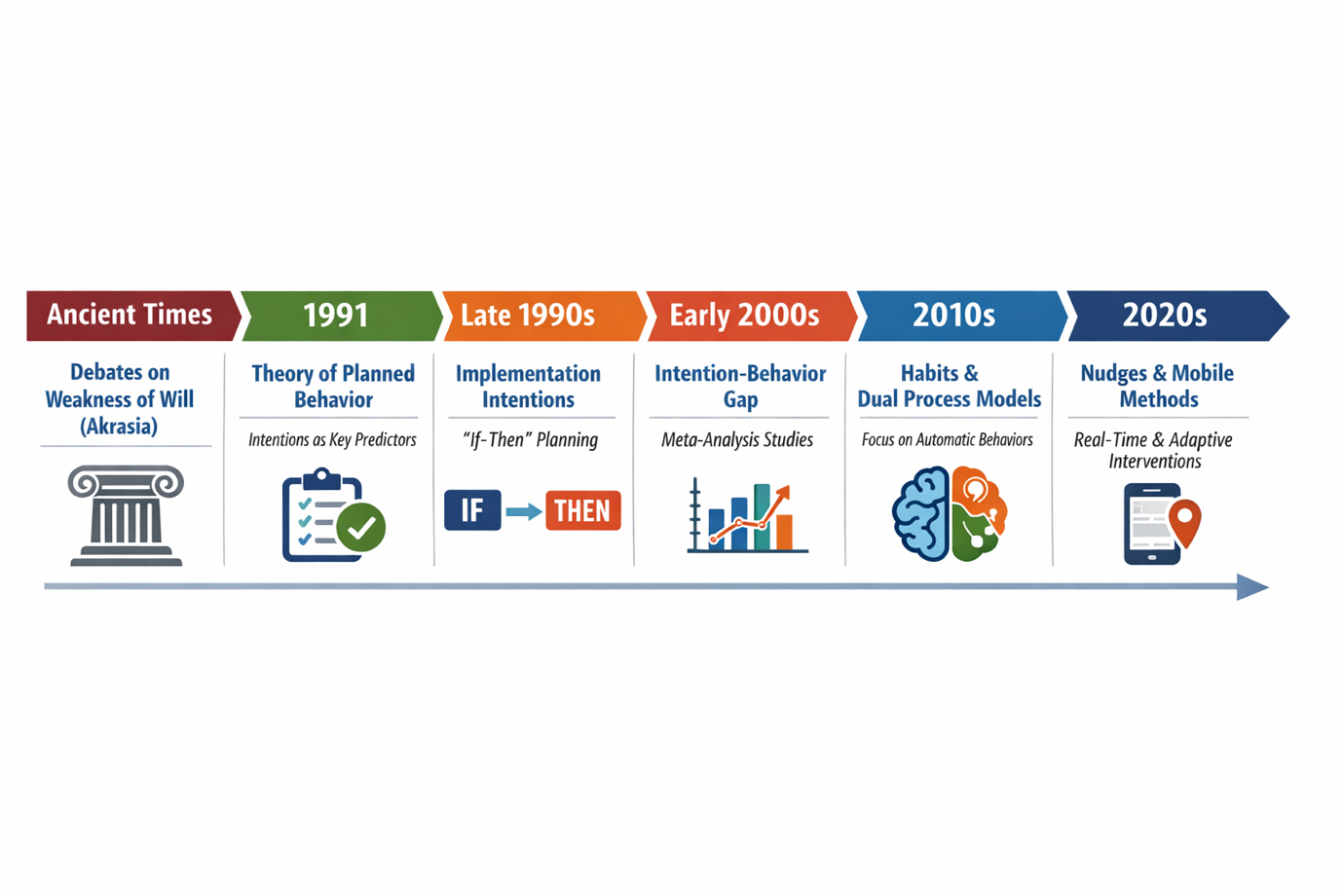
Long before modern behavioural science, philosophers wrote about the problem of people failing to do what they judged to be best. This was often described as ‘weakness of will’, or akrasia, – a term inherited from Aristotle and the Greeks. The central issue was the difference between deciding and following through, – i.e. how it is possible for a person to know the good, choose the good, and yet fail to do it (Stanford Encyclopedia of Philosophy, 2025). This ancient puzzle remains, in many ways, the animating question behind the modern research reviewed in this paper.
During the late twentieth century, psychology became more precise about this problem. Researchers increasingly separated ‘motivation’ from ‘volition’: motivation concerns wanting a goal, while volition concerns carrying it out. As Heckhausen (2007) observed, this distinction marked an important shift, – from asking why people want things to asking how they translate wanting into doing. At the same time, intention-based models such as the Theory of Planned Behaviour helped formalise how attitudes, norms, and perceived control shape intention (Ajzen, 1991), – thus giving researchers a clearer framework for understanding the antecedents of action.
From the late 1990s into the 2000s, practical interventions became more prominent. Implementation intentions, especially if–then plans, emerged as one of the most widely tested tools for helping intentions become action. As Gollwitzer (1999) demonstrated, these simple planning structures could significantly increase follow-through by linking a cue to a response in advance. Behavioural economics also contributed models showing how deadlines, commitment devices, and incentives could help people counter procrastination and present bias (O’Donoghue and Rabin, 1999; Ariely and Wertenbroch, 2002), – i.e. the field began to move from description to intervention, from diagnosis to design.
In the 2010s and 2020s, three further developments became especially important. First, greater attention to habit and automaticity, – recognising that much of human behaviour operates below the level of conscious intention (Gardner, de Bruijn and Lally, 2011). Second, larger replication efforts that challenged strong claims about some self-control mechanisms, – thus forcing the field to reconsider what had been taken for granted (Hagger et al., 2016). And third, the growth of mobile and real-time methods for studying behaviour in everyday settings (Shiffman, Stone and Hufford, 2008; Klasnja et al., 2015), – bringing the science closer to the texture of lived experience, where intentions succeed or fail in the moment.
4. Major Theoretical Frameworks and Mechanisms
A useful way to organise the literature is to treat the gap as a multi-cause problem. Different theories focus on different parts of the process: how intentions are formed, how action begins, how people stay on track, and how they adjust after feedback (Sheeran and Webb, 2016; Conner and Norman, 2022). What follows is an overview of the major frameworks, – each illuminating a different dimension of the intention–execution relationship.
4.1 Reasoned Action / Theory of Planned Behaviour (TPB)
This theory holds that behaviour is strongly shaped by intention. People are more likely to act when they evaluate the behaviour positively, believe relevant others approve, and feel capable of carrying it out. As Ajzen (1991) and Fishbein and Ajzen (2010) have demonstrated, the model is strong for predicting behaviour, especially in health, safety, and consumer settings.
However, critics argue that it does not fully explain the move from intention to sustained action (Conner and Norman, 2022), – i.e. it tells us much about how intentions form, but less about how they survive contact with reality.
4.2 Volition and action-phase models
These models argue that choosing a goal is not the same as doing it. Their focus is the transition from decision to action, – including planning, goal shielding, and the mental shift sometimes described as ‘crossing the Rubicon’. As Gollwitzer (2012) and Gollwitzer and Oettingen (2020) have observed, this distinction between the ‘motivational’ and ‘volitional’ phases of goal pursuit is essential, – for the psychology of deciding is not the psychology of executing.
These models are especially useful in health, education, and workplace goal pursuit, – wherever the challenge lies not in forming the intention but in translating it into consistent action.
4.3 Implementation intentions (if–then plans)
This framework links a specific cue to a specific response, – for example: ‘if it is 7 am, then I will walk for 20 minutes’. The logic is that the cue becomes easier to detect and the action becomes easier to start automatically, – i.e. the plan creates a kind of mental automation that reduces the burden on conscious will.
As Gollwitzer (1999) and Gollwitzer and Sheeran (2006) have demonstrated, this is one of the strongest and most practical intervention lines in the literature. Its power lies in its simplicity: rather than relying on motivation in the moment, it pre-commits the person to a course of action triggered by an environmental cue.
4.4 Control theory / cybernetic self-regulation
This perspective treats behaviour as a feedback loop. People compare current performance with a desired standard and then adjust behaviour to reduce the discrepancy. As Carver and Scheier (1981, 2002) have articulated, behaviour is not a linear progression but a cyclical process of comparison, correction, and adjustment.
This framework places strong emphasis on monitoring, feedback, and corrective action, – and it is especially relevant to work goals, learning progress, and health tracking. As Harkin et al. (2016) have shown, the presence of feedback loops significantly improves follow-through, – for people cannot correct what they do not measure.
4.5 Habit and dual-process models
These models argue that behaviour is often driven by learned cue–response patterns rather than by reflective choice alone. As Gardner, de Bruijn and Lally (2011) and Wood and Rünger (2016) have observed, much of what we do operates below the level of conscious intention, – i.e. habit, not decision, governs the majority of daily action.
This helps explain why strong intentions may still fail if old habits are stronger than the new plan. The framework is especially useful for repetitive behaviours such as diet, exercise, and digital routines, – where the challenge is not forming a new intention but overwriting an existing automaticity.
4.6 Temporal Self-Regulation Theory
This theory argues that intention translation depends not only on motivation but also on executive function, behavioural prepotency, and the timing of costs and benefits. As Hall and Fong (2007, 2015) have observed, behaviours that carry immediate effort but delayed reward present a particular challenge, – for the structure of time itself works against execution.
This is especially useful for understanding exercise, health-related routines, and other actions where the payoff lies in the future but the discomfort is felt now.
4.7 Present bias and procrastination models
These models show how people can make sensible long-term plans and then deviate when the present moment arrives and immediate comfort becomes more attractive. As O’Donoghue and Rabin (1999) and Ariely and Wertenbroch (2002) have demonstrated, this is not irrational in the simple sense, – it is ‘predictably irrational’, a systematic pattern in which the immediate consistently defeats the important.
These models are especially relevant to study behaviour, saving, health adherence, and other situations in which short-term temptation disrupts long-term intention, – i.e. wherever the self of today betrays the plans of the self of yesterday.
4.8 Choice architecture, nudges, and friction
This framework focuses on how small changes in the environment can shape behaviour even when intention stays the same. Defaults, reminders, simplification, and friction reduction are central here. As Mertens et al. (2022) and Sunstein (2020) have observed, these interventions work not by changing minds but by changing contexts, – i.e. by making the desired action easier and the undesired action harder.
The framework is most useful in administrative, consumer, and public-policy settings, although effects vary considerably across contexts. Its deeper insight is that behaviour is shaped not only by what we want but by what the environment makes available.
4.9 Identity-based approaches
Identity-based theories argue that behaviour becomes more durable when it feels consistent with who the person is or wants to become. As Oyserman et al. (2017) have observed, action that answers the question ‘Who am I becoming?’ is more likely to persist than action that merely answers ‘What should I do?’
This is especially relevant in education, health, and prosocial action, – where meaning and self-interpretation can shape persistence. The implication is profound: sustainable behaviour change may require not merely new habits but a new sense of self.
4.10 Socio-structural and practice-based accounts
These accounts argue that the gap is not always located inside the individual. Norms, routines, infrastructure, price, access, and system design can all shape whether action is possible. As Shove (2010), Kollmuss and Agyeman (2002), and Hassan, Shiu and Shaw (2016) have observed, individuals do not act in a vacuum, – they act within structures that constrain and enable.
This perspective is particularly important in sustainability, food practices, and organisational behaviour, – wherever the individual’s best intentions collide with systemic obstacles. It reminds us that the gap is not purely psychological; it is also social, material, and institutional.
4.11 Willpower-as-resource (ego depletion tradition)
This model proposed that self-control behaves like a limited resource that becomes weaker after use, – i.e. that willpower is a kind of fuel that can be exhausted. It was highly influential for many years, shaping both academic research and popular understanding of self-discipline.
However, large replication studies later found far weaker evidence than expected (Hagger et al., 2016; Dang et al., 2021). The idea remains relevant historically, but it is now treated much more cautiously, – a reminder that even well-established findings must remain open to revision in the light of new evidence.
5. Cross-Cutting Mechanisms Currently Most Supported
Across the different theories, several mechanisms recur again and again. These include intention strength and stability, progress monitoring, habit strength, friction and opportunity, present bias, and emotional avoidance. Taken together, they suggest that the gap is usually best understood as a multi-cause problem rather than as a simple failure of motivation (Sheeran and Webb, 2016; Conner and Norman, 2022). In other words, – there is no single explanation for why intentions fail; there are many, operating at different levels and in different combinations.
5.1 Intention strength and stability
Intentions work better when they remain strong and stable over time. A person may sincerely intend to act on Monday, yet if that intention weakens by Thursday it becomes a poor guide to behaviour. As Conner and Norman (2022) and Cooke and Sheeran (2004) have demonstrated, stable intentions predict behaviour far better than unstable ones, – i.e. it is not enough to decide once; the decision must be sustained.
This is a critical insight. Many systems assume that the act of goal-setting confers permanence, – as if intention, once formed, will remain psychologically active until execution. The evidence suggests otherwise. Intentions decay, drift, and are displaced by competing demands. The first mechanism of the gap, therefore, is the instability of intention itself.
5.2 Action control, monitoring, and feedback
People are more likely to follow through when they measure progress, compare outcomes with goals, and make adjustments. As Carver and Scheier (2002) and Harkin et al. (2016) have observed, progress monitoring becomes especially effective when it is recorded, reviewed, or shared, – because the feedback becomes concrete and harder to ignore.
This aligns closely with control-theory models, which treat execution not as a linear effort but as a cyclical process of comparison, correction, and adjustment. The implication is clear: people cannot correct what they do not measure. Systems that make discrepancies visible are systems that support follow-through.
5.3 Habit strength and automaticity
Many actions are triggered by familiar cues rather than by repeated conscious choice. This means a person can hold a good intention yet still revert to an older routine if that routine is more established. As Gardner, de Bruijn and Lally (2011) and Wood and Rünger (2016) have observed, changing behaviour often requires changing the cue, the setting, or the routine itself, – i.e. the battle is not only with desire but with automaticity.
This is why willpower alone is often insufficient. The new intention must compete against the weight of accumulated habit, – and habit, operating below the level of conscious reflection, often wins.
5.4 Friction, opportunity, and environment
Behaviour is often blocked by forms, delay, uncertainty, effort, or lack of access. These kinds of barriers matter because some failures of follow-through are really failures of opportunity rather than failures of values or care. As Michie, van Stralen and West (2011) and Sunstein (2020) have observed, the path to action may be obstructed not by weak motivation but by practical difficulty.
This is one reason the COM-B model remains influential, – for it recognises that behaviour requires not only motivation but also capability and opportunity. A person may genuinely want to act, yet find the action blocked by friction that has nothing to do with desire.
5.5 Present bias and short-term temptation
People often overweight what feels easier, safer, or more rewarding right now and underweight future benefits. As O’Donoghue and Rabin (1999) and Hall and Fong (2015) have demonstrated, this ‘present bias’ helps explain why actions such as study, exercise, and saving are often difficult to sustain, – for the structure of time itself works against the long-term plan.
This is not irrationality in the simple sense. It is a predictable pattern in which the immediate consistently defeats the important, – the self of today betraying the plans of the self of yesterday.
5.6 Emotion, avoidance, and self-control
The gap is not only cognitive. Action is often blocked by fear, doubt, embarrassment, uncertainty, or aversion. As van Gelderen, Kautonen and Fink (2015) have observed in research on entrepreneurial action, self-control often matters by helping people move through emotionally difficult moments, – i.e. the challenge is not merely knowing what to do, but facing the feelings that arise when doing it.
This is a dimension often underestimated in productivity and planning systems. People avoid not merely what they forget, but what they fear. The emotional texture of the action itself, – its threat, its ambiguity, its cost to the self, – can be as powerful a barrier as any external obstacle.
6. Empirical Landscape and Domain-Specific Findings
The evidence across domains points to the same broad pattern: intention helps predict behaviour, but it does not guarantee it. As Sheeran and Webb (2016) and Conner and Norman (2022) have shown, this finding is robust across health, education, entrepreneurship, and work settings, – i.e. the gap is not confined to any single domain but appears wherever human beings attempt to translate purpose into practice.
Experimental evidence reinforces the same point. When intention becomes stronger, behaviour often improves only modestly. As Webb and Sheeran (2006) have demonstrated, this is one of the clearest reasons researchers treat the gap as a substantive problem rather than a statistical artefact, – i.e. the gap is real, not merely a measurement error.
6.1 Health and health behaviour
Health is one of the most studied areas in this field. Many people intend to exercise, eat well, take medication properly, or attend screening appointments, – yet many fail to follow through consistently. As Sheeran and Webb (2016) and Feil, Fritsch and Rhodes (2023) have observed, this persistent gap has pushed health psychology toward a stronger focus on planning, action control, monitoring, and habit rather than on persuasion alone.
The implication is significant: changing what people believe or want is not enough. The real challenge lies in helping them do what they already intend to do.
6.2 Education and procrastination
In education, the gap is often studied through ‘procrastination’. Students may intend to study, revise, write, or submit work on time but still delay action until pressure becomes acute. As Steel (2007) and O’Donoghue and Rabin (1999) have observed, the literature links procrastination strongly to task aversiveness, impulsiveness, and present bias, – i.e. students avoid not because they do not care, but because the work feels difficult, unpleasant, or emotionally threatening.
This is a domain where the intention–execution gap is experienced acutely and repeatedly, – and where the costs of non-execution are often painfully visible.
6.3 Entrepreneurship and start-up action
Entrepreneurship provides another useful case. Many people say they want to start a business, but far fewer take the concrete steps needed to make that happen. As van Gelderen, Kautonen and Fink (2015) have observed, research in this area shows that emotional factors such as fear, doubt, and aversion often sit between intention and action, – i.e. the gap is not merely cognitive but affective.
This domain is particularly illuminating because the stakes are high and the actions are visible. The distance between ‘wanting to start a business’ and ‘actually starting one’ reveals the full weight of the intention–execution problem.
6.4 Workplace goals and performance
In work settings, the gap often appears between setting a target and carrying it out consistently. As Locke and Latham (2002) and Harkin et al. (2016) have demonstrated, goal-setting research shows that challenging goals can improve performance, but only when feedback, commitment, and systems support are in place.
In this sense, the workplace version of the gap often becomes an execution-system problem rather than a pure motivation problem, – i.e. organisations, like individuals, can know what they ought to do and yet persistently fail to do it. The challenge is not in the goal but in the infrastructure that supports its realisation.
7. Practical Interventions and Productivity Frameworks
The practical literature suggests that the best interventions work by clarifying the next action, strengthening the cue, increasing feedback, or improving the environment. As Gollwitzer and Sheeran (2006), Harkin et al. (2016), and Michie, van Stralen and West (2011) have demonstrated, the most effective tools share a common logic: they do not merely strengthen motivation but restructure the conditions under which action occurs. The strongest lines of evidence are summarised below.
7.1 Implementation intentions
If–then plans are one of the best supported tools in the literature. They specify what will be done, under what cue, and often how obstacles will be handled. As Gollwitzer (1999) and Gollwitzer and Sheeran (2006) have shown, this reduces ambiguity and makes action easier to initiate in the relevant moment, – i.e. the plan creates a kind of mental automation that reduces the burden on conscious will.
The power of this intervention lies in its simplicity. Rather than relying on motivation at the moment of action, it pre-commits the person to a course of behaviour triggered by an environmental cue. In this sense, – the if–then plan delegates execution from the reflective self to the reactive self.
7.2 Progress monitoring and feedback
People do better when they regularly inspect results, compare performance with goals, and adjust. As Harkin et al. (2016) have demonstrated, meta-analytic evidence suggests that this effect strengthens when progress is written down, reviewed publicly, or made easier to see, – for feedback that remains invisible exerts no corrective force.
This aligns with the control-theory models discussed earlier. Execution is not a matter of effort alone; it is a matter of repeated comparison, correction, and adjustment. The systems that work are those that make discrepancies visible, – and thereby make correction possible.
7.3 Mental contrasting with implementation intentions (MCII / WOOP)
This method combines a desired outcome with a realistic identification of internal obstacles and then adds an if–then plan for how those obstacles will be handled. As Wang, Wang and Gai (2021) have observed, it is especially useful when the barrier is not only forgetfulness but also inner hesitation or conflict, – i.e. when the obstacle lies not outside but within.
The value of this approach is that it integrates both the motivational and the volitional dimensions, – acknowledging the gap between wanting and doing, and building a bridge across it.
7.4 Choice architecture, nudges, and friction reduction
Some interventions work not by changing intention but by redesigning the situation around the choice. Defaults, reminders, simplification, and easier pathways can all help. As Mertens et al. (2022) and Michie, van Stralen and West (2011) have observed, these interventions work not by changing minds but by changing contexts, – i.e. by making the desired action easier and the undesired action harder.
The size of the effect varies greatly across domains, – but the underlying insight is significant: behaviour is shaped not only by what we want but by what the environment makes available.
7.5 Commitment devices, deadlines, and incentives
These tools aim to make future follow-through more binding. As Ariely and Wertenbroch (2002), Volpp et al. (2008), and Bai et al. (2021) have demonstrated, they can be effective, especially for initiation, – but effects are often uneven and sometimes fade when the external support is removed.
This is an important qualification. External structures can support action, but they do not always produce lasting change. The deeper question is whether the behaviour can become self-sustaining, – i.e. whether the external scaffold can eventually be withdrawn without collapse.
7.6 What productivity frameworks get right
A surprising amount of practical productivity advice aligns with the literature when it tells people to define the next action clearly, track what they do, and design their environment deliberately. As Gollwitzer and Sheeran (2006), Harkin et al. (2016), and Mertens et al. (2022) have shown, these are precisely the mechanisms with the strongest empirical support.
The weaker forms of advice are those that rely too heavily on vague willpower, inspiration, or self-judgement, – i.e. on the assumption that motivation alone will carry intention into action. The literature suggests otherwise. What is needed is not merely desire but structure, not merely purpose but process.
8. Gaps, Controversies, and Future Research Directions
The field has made real progress, but important disagreements remain. The biggest issue is that intention clearly predicts some behaviour, yet it does not fully explain how action is initiated, sustained, or repaired after failure. As Webb and Sheeran (2006) and Conner and Norman (2022) have observed, this has pushed the field toward more practical questions about what happens between deciding and doing, – i.e. toward the territory where intention meets reality.
8.1 The debate over the Theory of Planned Behaviour
The Theory of Planned Behaviour remains highly influential, but critics argue that it is too limited if it stops at attitudes, norms, control, and intention. As Sniehotta, Presseau and Araújo-Soares (2014) and Conner and Norman (2022) have observed, many researchers now treat it as a useful base rather than a complete explanation, – i.e. as a starting point for understanding intention formation, but not a sufficient account of intention translation.
The question is not whether the theory is wrong, but whether it is enough. And the consensus appears to be that it is not.
8.2 The debate over willpower and ego depletion
Ego depletion was once treated as a strong explanation of self-control failure, – the idea that willpower behaves like a limited resource that becomes weaker after use. But large replication projects later found far weaker evidence than expected (Hagger et al., 2016; Dang et al., 2021; Vohs et al., 2021).
Current work treats the model far more cautiously and is more likely to emphasise context, monitoring, habit, and emotion. This is a salutary reminder that even well-established findings must remain open to revision in the light of new evidence, – and that the science of self-control is still evolving.
8.3 The debate over nudges: effectiveness and ethics
Choice-architecture interventions work on average, but their effects vary and their ethical status remains contested. As Mertens et al. (2022), Sunstein (2015), Hu et al. (2025), and Gerver, Banerjee and John (2024) have observed, questions of transparency, autonomy, fairness, and consent now sit alongside the question of effectiveness, – i.e. the debate is no longer merely about ‘Does it work?’ but also about ‘Is it right?’
This is an important evolution. The power to shape behaviour carries with it the responsibility to do so ethically, – and the boundaries of that responsibility are still being drawn.
8.4 Real-time behavioural support
One of the strongest future directions is the move toward real-time methods, including ecological momentary assessment, micro-randomized trials, and just-in-time adaptive interventions. As Shiffman, Stone and Hufford (2008) and Klasnja et al. (2015) have demonstrated, these methods fit the problem well because the gap often appears in small but important moments of choice rather than only in long-range planning.
This represents a significant shift, – from studying behaviour retrospectively to studying it as it unfolds, in the texture of lived experience. The science is moving closer to the moment where intentions succeed or fail.
8.5 Friction and sludge
Another promising direction is the direct study of friction, or ‘sludge’. As Sunstein (2020) and OECD (2024) have observed, this perspective highlights how forms, delay, confusion, and other small burdens can prevent people from doing what they already intend to do, – i.e. how the environment itself can obstruct action even when motivation is strong.
This is a crucial insight. Not all failures of follow-through are failures of will; some are failures of opportunity, – and the difference matters enormously for intervention design.
8.6 Identity and immediate context
Identity-based motivation research suggests that the meaning of a behaviour depends partly on which identity is active in the moment. As Oyserman et al. (2017) have observed, this may explain why identity-based interventions are powerful in some settings yet uneven in others, – for the self is not a fixed entity but a shifting constellation of identities, each with its own implications for action.
This opens a deeper question: if behaviour depends not only on what we want but on who we are in the moment, then sustainable change may require not merely new habits but a new sense of self.
9. Actionable Research Recommendations
Future research should measure real behaviour, not only stated intention. As Conner and Norman (2022) and Shiffman, Stone and Hufford (2008) have observed, whenever possible, behaviour should be observed through logs, attendance records, wearable data, purchasing records, or other objective indicators rather than through delayed self-report alone, – for what people say they did is not always what they actually did.
Researchers should also make intention measures and behaviour measures match more closely. Broad questions about wanting to be healthier are not ideal if the real outcome is a very specific action such as walking for 20 minutes on Monday morning (Conner and Norman, 2022). The principle here is one of correspondence, – the level of abstraction in the intention must match the level of specificity in the behaviour.
Intentions should be measured more than once. Many studies treat intention as stable, even though in real life it can change across hours or days. Repeated measurement would help distinguish weak intentions from unstable intentions (Conner and Norman, 2022), – i.e. it would reveal not only whether an intention exists, but whether it persists.
Real-time methods such as ecological momentary assessment and adaptive designs such as micro-randomized trials are especially promising because they can capture the moment-level processes at which action breaks down or support works best (Shiffman, Stone and Hufford, 2008; Klasnja et al., 2015). This represents a significant methodological advance, – moving the science closer to the texture of lived experience, where intentions succeed or fail in the moment.
At the same time, personalised digital interventions should not be oversold. As Hardeman et al. (2019) and Klasnja et al. (2015) have observed, the evidence on just-in-time adaptive interventions remains promising but still mixed, and stronger testing is still needed, – i.e. the potential is real, but so is the need for caution.
The strongest future work will likely combine objective data, self-report, and context-sensitive information. It should also distinguish more clearly between starting a behaviour, maintaining it, and recovering after drift, – for these are not the same challenge, and they may require different supports. The next step for the field is not simply a new theory, but better methods for seeing what actually happens between intention and action in everyday life (Conner and Norman, 2022; Klasnja et al., 2015), – i.e. methods that illuminate the territory where purpose meets practice.
Appendix A: Application of the Literature to AQMeets
This appendix applies the main findings of the report to AQMeets. It has two purposes. First, it considers the extent to which the strongest mechanisms, interventions, and productivity principles identified in the literature are already reflected in the design of AQMeets. Second, it identifies important ideas that are not yet fully represented and proposes these as future directions for development.
This appendix is interpretive rather than experimental. It does not claim that AQMeets has already been evaluated in formal trials comparable to the academic interventions reviewed in the main body of the report. Instead, it asks whether the structure and logic of AQMeets align with the best current research on how intention becomes sustained action, – i.e. whether its design embodies, whether consciously or intuitively, the lessons that the behavioural sciences have laboured to uncover.
A.1 AQMeets as a response to the intention–execution gap
At a broad level, AQMeets can be understood as a practical response to the central problem identified throughout this report: people often hold genuine intentions but fail to translate them into consistent, organised action (Sheeran and Webb, 2016; Conner and Norman, 2022). Rather than treating this as a simple failure of motivation, – as if the solution were merely to ‘try harder’, – AQMeets is organised around a deeper assumption: that intention requires structure, review, accountability, and repeated translation into concrete next steps.
What distinguishes AQMeets from a basic planning tool is that it does not treat goal setting as a one-off event. Instead, it is structured as an ongoing cycle of reflection, planning, review, and behavioural correction. This is consistent with the literature, which shows that intention weakens when it is not revisited, measured, and linked repeatedly to present action (Cooke and Sheeran, 2004; Conner and Norman, 2022). In other words, – the act of deciding is merely the beginning; what is required is a sustained discipline of reconnection between purpose and practice.
A.2 Areas in which AQMeets already reflects the literature
AQMeets reflects the literature particularly well in five areas: intention stability through repeated review cycles, progress monitoring, the conversion of broad aims into concrete action, rhythm and behavioural regularity, and the linking of action with meaning and identity. Each of these represents a dimension in which AQMeets has, whether consciously or intuitively, absorbed the core lessons of behavioural science.
Its layered cadence of Annual Aims, Quarterly Quests, Monthly Masteries, Weekly Wraps, and Daily Directives helps stabilise intention over time. Rather than relying on one initial burst of clarity, the system reconnects users with their broader aims at repeated intervals. This is important because the literature shows that stable intentions are far more predictive of action than unstable ones (Conner and Norman, 2022; Cooke and Sheeran, 2004), – i.e. it is not enough to decide once; the decision must be sustained.
Its recurring review structures also align closely with the evidence on progress monitoring and feedback. Weekly review cycles function not merely as reflection, but as points at which intention and behaviour are explicitly compared. As Carver and Scheier (2002) and Harkin et al. (2016) have demonstrated, this maps well onto control-theory accounts of self-regulation, – which treat execution as a process of repeated comparison, correction, and adjustment rather than simple effort.
AQMeets also reflects the literature by forcing a descent from broad vision into practical next steps. Many failures of execution stem not from weak desire but from vague action definition, – from not knowing ‘what next’ rather than not wanting to proceed. By translating large aims into quarterly, monthly, weekly, and daily commitments, the system reduces ambiguity and lowers the mental barrier to initiation (Gollwitzer, 1999; Gollwitzer and Sheeran, 2006).
More broadly, AQMeets treats execution as a rhythm rather than as a mood-dependent event. This is consistent with the literature on habit and repetition, which suggests that stable structures often matter more than occasional bursts of inspiration (Gardner, de Bruijn and Lally, 2011; Wood and Rünger, 2016), – i.e. consistency arises from discipline, not from desire.
Finally, AQMeets has an important strength in the way it frames execution as part of a larger story of meaning, responsibility, and self-authorship. This aligns with identity-based approaches, which suggest that action becomes more durable when it feels coherent with the kind of person one is trying to become (Oyserman et al., 2017). It is this dimension, – the linking of productivity with purpose, of technique with identity, – that may be one of AQMeets’ clearest points of distinction.
A.3 Important ideas not yet fully represented in AQMeets
Although AQMeets already aligns with many of the strongest findings in the literature, several areas remain underdeveloped and present clear opportunities for future growth. What follows is an exploration of these dimensions, – each representing a territory in which AQMeets could become more precise and more powerful.
First, the system could integrate more explicit if–then planning. As Gollwitzer and Sheeran (2006) have demonstrated, cue–response plans are among the most reliable tools for helping people act in the right moment. Future versions could ask not only what users plan to do, but when, where, under what cue, and what alternative plan they will use if an obstacle appears, – thus making the translation from intention to behaviour more precise.
Second, AQMeets could do more to diagnose emotional avoidance. As van Gelderen, Kautonen and Fink (2015) have observed, action often fails not because the goal is unclear, but because the action itself feels threatening, embarrassing, or aversive, – i.e. people avoid not merely what they forget, but what they fear. Future review prompts could therefore ask what task was avoided, what feeling was attached to it, and what smaller entry step would reduce resistance.
Third, the system could distinguish more clearly between initiation, maintenance, and recovery. As Hardeman et al. (2019) and Conner and Norman (2022) have noted, some interventions help people begin but are weaker at helping them continue over time. AQMeets could therefore develop different supports for starting, sustaining, and restarting behaviour, – recognising that execution unfolds in phases, and that the tools needed at each phase are not always the same.
Fourth, the platform could include more direct tools for habit and environment redesign. As Gardner, de Bruijn and Lally (2011) and Sunstein (2020) have observed, behaviour often changes more reliably when cues, defaults, and friction points are redesigned rather than when motivation is merely restated, – i.e. the environment itself must be made to support the desired action.
Fifth, AQMeets could address present bias more directly through visible deadlines, pre-commitment structures, consequence mapping, and prompts targeted at likely moments of drift (O’Donoghue and Rabin, 1999; Ariely and Wertenbroch, 2002), – i.e. through mechanisms designed to counter the short-term pull that so often defeats long-term plans.
Sixth, a major future direction would be more real-time and adaptive support. The current design is strongest as a review and planning system, – i.e. it excels in periodic reflection rather than moment-to-moment intervention. Future development could add moment-level prompts, drift detection, mood or energy check-ins, and more immediate corrective feedback (Shiffman, Stone and Hufford, 2008; Klasnja et al., 2015), – moving AQMeets closer to being a live execution-support environment.
Finally, AQMeets could become stronger by measuring actual behaviour more directly through completed-action logs, streak data, dashboards, pattern summaries, or integrations with external tools. As Conner and Norman (2022) and Shiffman, Stone and Hufford (2008) have observed, this would deepen the system’s feedback function and make the gap between stated plan and actual action more visible, – for people cannot correct what they do not measure.
A.4 Overall assessment
Taken as a whole, AQMeets is already directionally aligned with many of the strongest ideas in the literature. Its layered review cycles, movement from broad aims to concrete action, and emphasis on feedback, rhythm, and reflection all fit closely with current thinking about the intention–execution gap. In this sense, AQMeets is not merely another productivity tool; it is a system that has, whether consciously or intuitively, absorbed the core lessons of behavioural science.
The clearest future opportunities lie in more explicit if–then planning, better diagnosis of emotional resistance, stronger habit and friction redesign, a clearer distinction between starting and sustaining, more real-time adaptive support, and stronger measurement of actual behaviour. Each of these represents a dimension in which current research offers practical guidance that could deepen AQMeets’ effectiveness, – i.e. sharper instruments to serve its existing vision.
Its long-term advantage may lie precisely in this synthesis, – in combining philosophical depth and identity-based meaning with increasingly precise behavioural design, stronger feedback loops, and more moment-level support for execution. What distinguishes AQMeets is not merely its techniques but its vision: it treats the human being not as a machine to be optimised, but as a person seeking to author a meaningful life.
The task ahead is to strengthen this vision with sharper instruments, – so that the bridge between intention and action becomes not only philosophically sound, but practically traversable.
References
Ajzen, I. (1991) ‘The theory of planned behavior’, Organizational Behavior and Human Decision Processes, 50(2), pp. 179–211.
Ariely, D. and Wertenbroch, K. (2002) ‘Procrastination, deadlines, and performance: self-control by precommitment’, Psychological Science, 13(3), pp. 219–224.
Bai, L., Handel, B., Miguel, E. and Rao, G. (2021) ‘Self-control and demand for preventive health: evidence from hypertension in India’, Review of Economics and Statistics, 103(5), pp. 835–855.
Carver, C.S. and Scheier, M.F. (1981) Attention and Self-Regulation: A Control-Theory Approach to Human Behavior. New York: Springer.
Carver, C.S. and Scheier, M.F. (2002) ‘Control processes and self-organization as complementary principles underlying behavior’, Personality and Social Psychology Review, 6(4), pp. 304–315.
Conner, M. and Norman, P. (2022) ‘Understanding the intention-behavior gap: The role of intention strength’, Frontiers in Psychology, 13, 923464.
Cooke, R. and Sheeran, P. (2004) ‘Moderation of cognition-intention and cognition-behaviour relations: a meta-analysis of properties of variables from the theory of planned behaviour’, British Journal of Social Psychology, 43(2), pp. 159–186.
Dang, J. et al. (2021) ‘A multilab replication of the ego depletion effect’, Social Psychological and Personality Science, 12(1), pp. 14–24.
Feil, K., Fritsch, J. and Rhodes, R.E. (2023) ‘The intention-behaviour gap in physical activity: a systematic review and meta-analysis of the action control framework’, British Journal of Sports Medicine, 57(19), pp. 1265–1271.
Fishbein, M. and Ajzen, I. (2010) Predicting and Changing Behavior: The Reasoned Action Approach. New York: Psychology Press.
Gardner, B., de Bruijn, G.-J. and Lally, P. (2011) ‘A systematic review and meta-analysis of applications of the Self-Report Habit Index to nutrition and physical activity behaviours’, Annals of Behavioral Medicine, 42(2), pp. 174–187.
Gerver, M., Banerjee, S. and John, P. (2024) ‘Nudging against consent is effective but lowers welfare’, Scientific Reports, 14, 14864.
Gollwitzer, P.M. (1999) ‘Implementation intentions: strong effects of simple plans’, American Psychologist, 54(7), pp. 493–503.
Gollwitzer, P.M. (2012) ‘Mindset theory of action phases’. In: Van Lange, P.A.M., Kruglanski, A.W. and Higgins, E.T. (eds.) Handbook of Theories of Social Psychology. London: Sage.
Gollwitzer, P.M. and Oettingen, G. (2020) ‘Changing behavior using the model of action phases’. In: Hagger, M.S., Cameron, L.D., Hamilton, K., Hankonen, N. and Lintunen, T. (eds.) The Handbook of Behavior Change. Cambridge: Cambridge University Press.
Gollwitzer, P.M. and Sheeran, P. (2006) ‘Implementation intentions and goal achievement: a meta-analysis of effects and processes’, Advances in Experimental Social Psychology, 38, pp. 69–119.
Hagger, M.S. et al. (2016) ‘A multilab preregistered replication of the ego-depletion effect’, Perspectives on Psychological Science, 11(4), pp. 546–573.
Hall, P.A. and Fong, G.T. (2007) ‘Temporal self-regulation theory: a model for individual health behavior’, Health Psychology Review, 1(1), pp. 6–52.
Hall, P.A. and Fong, G.T. (2015) ‘Temporal self-regulation theory: a neurobiologically informed model for physical activity behavior’, Frontiers in Human Neuroscience, 9, 117.
Hardeman, W., Houghton, J., Lane, K., Jones, A. and Naughton, F. (2019) ‘A systematic review of just-in-time adaptive interventions (JITAIs) to promote physical activity’, International Journal of Behavioral Nutrition and Physical Activity, 16, 31.
Harkin, B., Webb, T.L., Chang, B.P.I., Prestwich, A., Conner, M., Kellar, I., Benn, Y. and Sheeran, P. (2016) ‘Does monitoring goal progress promote goal attainment? A meta-analysis of the experimental evidence’, Psychological Bulletin, 142(2), pp. 198–229.
Hassan, L.M., Shiu, E. and Shaw, D. (2016) ‘Who says there is an intention–behaviour gap? Assessing the empirical evidence of an intention–behaviour gap in ethical consumption’, Journal of Business Ethics, 136(2), pp. 219–236.
Heckhausen, J. (2007) ‘The motivation-volition divide and its resolution in action-phase models of developmental regulation’, Research in Human Development, 4(3–4), pp. 163–180.
Hu, Y. et al. (2025) ‘Ethical dimensions of healthcare nudges: a PRISMA-ScR-guided scoping review and framework for responsible behavioral governance’, Frontiers in Public Health, 13, 1716466.
Klasnja, P., Hekler, E.B., Shiffman, S., Boruvka, A., Almirall, D., Tewari, A. and Murphy, S.A. (2015) ‘Microrandomized trials: an experimental design for developing just-in-time adaptive interventions’, Health Psychology, 34S, pp. 1220–1228.
Kollmuss, A. and Agyeman, J. (2002) ‘Mind the gap: why do people act environmentally and what are the barriers to pro-environmental behavior?’, Environmental Education Research, 8(3), pp. 239–260.
Locke, E.A. and Latham, G.P. (2002) ‘Building a practically useful theory of goal setting and task motivation: a 35-year odyssey’, American Psychologist, 57(9), pp. 705–717.
Mertens, S., Herberz, M., Hahnel, U.J.J. and Brosch, T. (2022) ‘The effectiveness of nudging: a meta-analysis of choice architecture interventions across behavioral domains’, Proceedings of the National Academy of Sciences, 119(1), e2107346118.
Michie, S., van Stralen, M.M. and West, R. (2011) ‘The behaviour change wheel: a new method for characterising and designing behaviour change interventions’, Implementation Science, 6, 42.
O’Donoghue, T. and Rabin, M. (1999) ‘Doing it now or later’, American Economic Review, 89(1), pp. 103–124.
OECD (2024) Fixing frictions: ‘sludge audits’ around the world: How governments are using behavioural science to reduce psychological burdens in public services. OECD Public Governance Policy Papers, No. 48. Paris: OECD Publishing.
Oyserman, D., Lewis, N.A. Jr, Yan, V.X., Fisher, O., O’Donnell, S.C. and Horowitz, E. (2017) ‘An identity-based motivation framework for self-regulation’, Psychological Inquiry, 28(2–3), pp. 139–147.
Pfeffer, J. and Sutton, R.I. (2000) The Knowing-Doing Gap: How Smart Companies Turn Knowledge into Action. Boston: Harvard Business School Press.
Shiffman, S., Stone, A.A. and Hufford, M.R. (2008) ‘Ecological momentary assessment’, Annual Review of Clinical Psychology, 4, pp. 1–32.
Shove, E. (2010) ‘Beyond the ABC: Climate change policy and theories of social change’, Environment and Planning A, 42(6), pp. 1273–1285.
Sheeran, P. and Webb, T.L. (2016) ‘The intention–behavior gap’, Social and Personality Psychology Compass, 10(9), pp. 503–518.
Sniehotta, F.F., Presseau, J. and Araújo-Soares, V. (2014) ‘Time to retire the theory of planned behaviour’, Health Psychology Review, 8(1), pp. 1–7.
Stanford Encyclopedia of Philosophy (2025) ‘Weakness of Will’.
Steel, P. (2007) ‘The nature of procrastination: a meta-analytic and theoretical review of quintessential self-regulatory failure’, Psychological Bulletin, 133(1), pp. 65–94.
Sunstein, C.R. (2015) ‘The ethics of nudging’, Yale Journal on Regulation, 32(2), pp. 413–450.
Sunstein, C.R. (2020) ‘Sludge audits’, Behavioural Public Policy, 6(4), pp. 654–673.
van Gelderen, M., Kautonen, T. and Fink, M. (2015) ‘From entrepreneurial intentions to actions: self-control and action-related doubt, fear, and aversion’, Journal of Business Venturing, 30(5), pp. 655–673.
Vohs, K.D. et al. (2021) ‘A multisite preregistered paradigmatic test of the ego-depletion effect’, Psychological Science, 32(10), pp. 1566–1581.
Volpp, K.G., John, L.K., Troxel, A.B., Norton, L., Fassbender, J. and Loewenstein, G. (2008) ‘Financial incentive-based approaches for weight loss: a randomized trial’, JAMA, 300(22), pp. 2631–2637.
Wang, G., Wang, Y. and Gai, X. (2021) ‘A meta-analysis of the effects of mental contrasting with implementation intentions on goal attainment’, Frontiers in Psychology, 12, 565202.
Webb, T.L. and Sheeran, P. (2006) ‘Does changing behavioral intentions engender behavior change? A meta-analysis of the experimental evidence’, Psychological Bulletin, 132(2), pp. 249–268.
Wood, W. and Rünger, D. (2016) ‘Psychology of habit’, Annual Review of Psychology, 67, pp. 289–314.