
Why Research Motivation?
Much of modern motivational thinking looks where the light is better. The Center for Motivation Research exists to look where the keys may actually be found.

Our Philosophy
There is an old joke that goes something like this.
A policeman sees a drunken man searching for something under a streetlight. He walks over and asks:
“Have you lost something, sir?”
The drunken man replies, “Yeaash. I sheem to have… hick… lost my keys.”
The policeman says, “I’ll help you look for them.”
So they both begin searching under the streetlight. Ten minutes pass. No keys.
The frustrated policeman finally asks, “Are you sure you lost them around here?”
The drunk man replies, “Well… hick… no. The keys are inside the house.”
“So why are we looking out here?” the policeman cries.
The drunken man says, “It’s dark inside the house. The light is much better here.”
If you have heard this joke before, that is understandable. Versions of it are very old. It has been told and retold because it illustrates a bias human beings have never fully escaped: we prefer to look where it is easiest to look, even when the thing we need is somewhere else.
That is especially relevant when we honestly assess much of the motivation research and leadership education on offer today.
The Illusion of Surface-Level Understanding
A great deal of modern motivational content has been created by surface-level theorists. They are trained to look where the light is better: where things are easiest to measure, quantify, compare, and convert into academic papers, reports, dashboards, frameworks, and credentials.
After all, who can argue with mathematical equations and statistical data?
It is in the nature of the modern scientific method to favour what is well lit: behaviours, responses, observable actions, measurable outcomes, and quantifiable indicators. These things matter. They should not be dismissed. But they are not the whole of motivation.
The deeper currents of human motivation are harder to measure: core desires, unconscious drives, intrinsic values, moral imagination, identity, longing, fear, and the true “why” behind human action.
Why are these deeper currents often neglected?
Because they are difficult to measure. And if a researcher goes too far into those depths, the work may become harder to defend in a narrow academic environment. It may not fit easily into a dataset, a grant proposal, a PhD structure, or a conventional publication model.
The incentive structure therefore leans toward the surface.
This is how many organisations approach motivation today. They conduct engagement surveys, deploy incentive programs, track superficial KPIs, and assume that because something can be measured, it is therefore the most important thing to understand.
But many of the strongest insights into human motivation have shown the limits of this approach. External incentives can sometimes produce results, but they can also distort action, weaken intrinsic interest, or produce the opposite of what was intended. The deeper motivational drivers — autonomy, mastery, purpose, meaning, responsibility, belonging, and identity — often remain hidden in the shadows.
A common example is the endless development of motivational techniques. These are often tabulated, measured, refined, and repackaged. One is then encouraged to apply them as if human motivation were a list of observable behaviours that could be copied.
The logic is simple: if successful motivators use certain techniques, then we should adopt those techniques and expect the same outcomes.
So great attention is placed on how former leaders presented, how they communicated, how they structured incentives, how they created campaigns, how they framed goals, how they gave speeches, how they used language, how they built systems, and so on.
With all this objective knowledge about motivation — with the certificates, diplomas, degrees, master’s degrees, PhDs, assessments, models, dashboards, and frameworks — one would expect us to be surrounded by great motivational leaders.
So why does public opinion, and often first-hand experience, tell a different story?

Beyond the Facade: The Search for Authentic Motivation
The reason is that copying motivational techniques, or merely enhancing an existing style, often produces little more than a facade of understanding.
It may look like motivation. It may sound like motivation. It may even perform motivation for a time. But it does not necessarily possess the depth required to understand what truly moves people.
The idea of a facade is close to Jung’s concept of the persona. It is the mask one presents to the world: the socially acceptable form, the professional appearance, the expected role. In the context of motivation, the facade is the appearance of understanding without the depth of understanding itself.
It is a mask made from borrowed techniques.
It may earn attention. It may exercise a function. It may use the language of leadership, psychology, coaching, performance, or inspiration. But it remains two-dimensional.
Great motivational leaders are never merely two-dimensional.
When we think of people who have truly shaped our understanding of motivation — figures such as Daniel Kahneman, Robert Cialdini, Carol Dweck, Victor Frankl, Abraham Maslow, Ernest Dichter, and others — they do not merely offer techniques. They offer a deeper way of seeing.
Take Carol Dweck’s work on growth mindset. The power of her work was not simply that she observed that some people believe abilities can be developed while others believe they are fixed. The deeper significance was in showing how a person’s relationship with failure, effort, learning, challenge, and human potential affects the way they act.
When organisations implement “growth mindset programs” without this deeper understanding, they often create what Dweck herself has called a false growth mindset: the language of growth without the underlying conversion of belief, practice, and culture.
True motivational understanding cannot be copied in a shallow way. Each serious motivation researcher, counsellor, educator, or leader has to develop depth of perception. They must learn to see what is actually moving people, not simply imitate the outward signs of someone else’s insight.
Think for a moment of the best motivation specialists, leaders, teachers, counsellors, or researchers you know.
What names come to mind?
What are they like?
Can you picture them?
Now consider this: were these people merely the product of superficial motivation training?
Were they formed by a few techniques, models, and measurable behaviours?
Or was there something deeper in them — a seriousness, an attentiveness, a capacity to see into human life?
That is the point.
The Fatal Flaw
The fatal flaw at the heart of much motivational thinking is one that psychology has long recognised:
Observable behaviour is the domain of surface science. Deep motivation belongs to the domain of depth psychology, meaning, desire, value, identity, and motivation research.
Motivation belongs primarily to the latter category.
This does not mean that a good motivation researcher ignores observable behaviour. A serious researcher should be attentive to behaviour, action, response, context, habit, and measurable outcomes. But motivation itself is concerned with the inner drivers that compel action.
It is concerned with the impulse beneath the action.
It asks not only what a person did, but why that act became meaningful enough to do.
The Methodologies of Deep Motivation Research
How, then, do we approach these hidden realms of motivation?
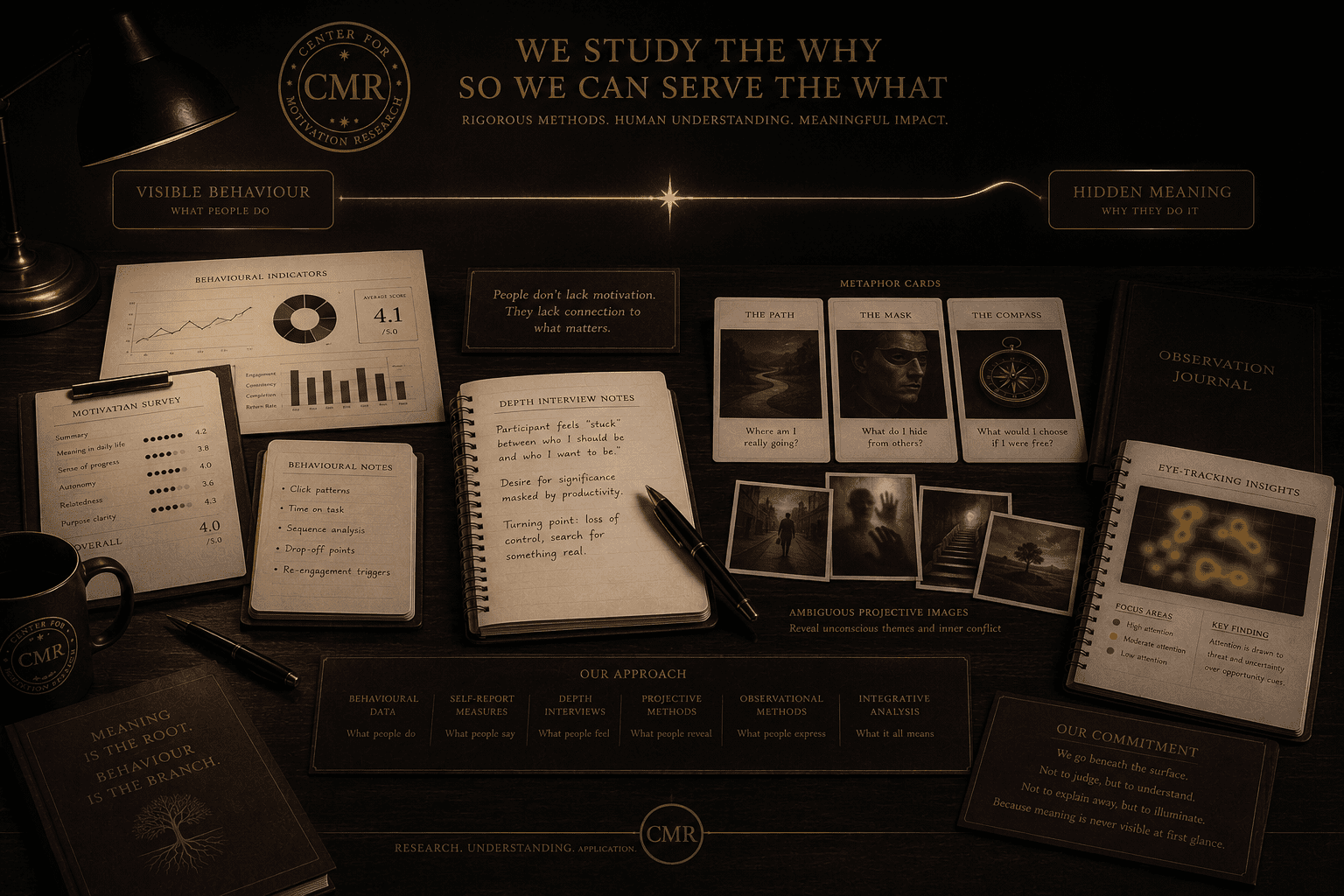
Deep motivation research has historically drawn on methods that go beyond surface surveys and simple behaviour tracking. Among these are:
Depth interviews
Unlike structured surveys, depth interviews allow a skilled interviewer to follow emotional threads, symbolic associations, contradictions, hesitations, and recurring themes. They are especially useful when people cannot yet clearly articulate what is driving them.
Projective techniques
Tools such as the Thematic Apperception Test ask people to respond to ambiguous material. The purpose is not merely to collect answers, but to reveal patterns of meaning, fear, desire, identity, and interpretation that may not appear in direct questioning.
Metaphor elicitation
Methods such as those developed by Gerald Zaltman ask people to use images and metaphors to express thoughts and feelings that are difficult to articulate directly. Such methods recognise that much of human motivation is carried through image, story, association, and symbol.
Ethnographic observation
Observation in natural settings can reveal the difference between what people say motivates them and what actually appears to shape their behaviour in context.
Psychophysiological measures
Modern tools such as eye-tracking, galvanic skin response, neuroimaging, and related approaches may offer partial windows into motivational processes that occur beneath conscious awareness.
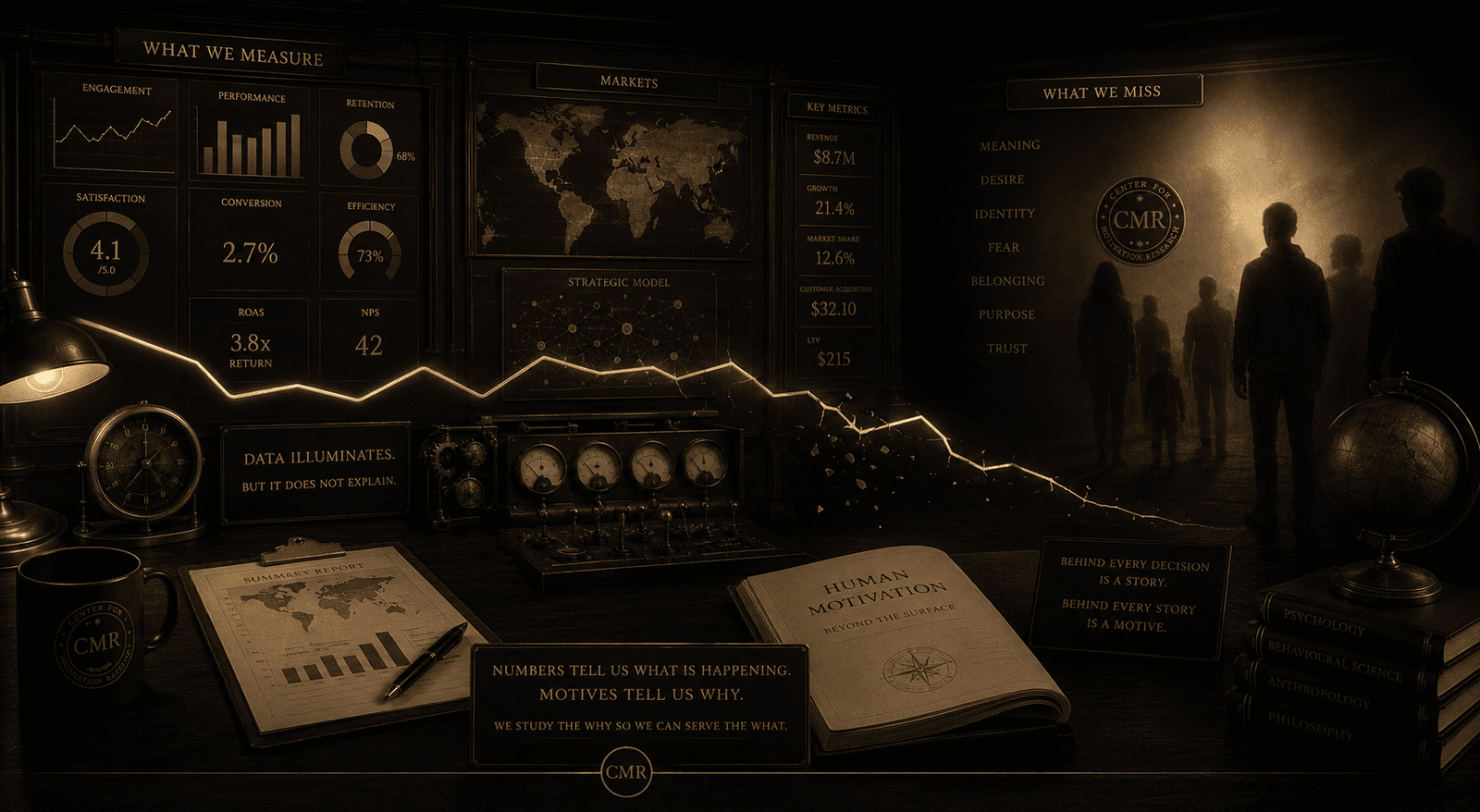
These methods matter because the force that compels action does not emerge from behaviour alone. The behaviour is visible. The compulsion is not.
The act can be measured. The meaning must be interpreted.
The deeper movement comes from the subjective pursuit of what a person recognises as significant. It comes from what he or she values, fears, desires, imagines, protects, resists, or seeks.
The process of understanding motivation is therefore a process of psychological depth recognition.
Surface science can classify behavioural properties and develop applications from them. But the interpretation of why people act always depends on a deeper story about human life.
For example, Abraham Maslow identified a hierarchy of needs, with self-actualisation near the top. Motivation researchers such as Ernest Dichter then helped bring depth psychology into the practical study of consumer behaviour, showing that products, brands, and choices were often tied to hidden meanings, not merely rational preferences.
One famous case associated with Dichter involved cake mixes in the 1950s. The issue was not simply product convenience. Women using the mix were said to experience a sense that the process was too easy, as though they had not truly contributed. The addition of an egg restored a sense of participation, care, and personal contribution.
Whether every detail of that story is repeated accurately in popular accounts is less important than the central lesson: surface-level research often misses the symbolic and emotional meaning of action.
People do not merely buy products, join movements, follow leaders, enrol in programs, or commit to work because of observable features. They act because something connects with value, identity, meaning, fear, hope, belonging, pride, or purpose.
Great motivation research therefore uses both modes of interpretation.
It studies observable behaviour.
It also studies deep drivers.
Both are necessary. To pit one against the other is to misunderstand the first principles of motivation. What we can see and what truly drives us are related, but they are not the same thing.
Bridging Modern Technology and Deep Understanding
None of this means that modern data analytics, behavioural science, or technology cannot enhance our understanding of motivation.
They can.
The strongest approaches today combine careful observation, behavioural evidence, data, and depth psychology.
We can see this in companies such as Apple, Zappos, Wikipedia, and others, each in a different way. Their influence cannot be explained by features, metrics, or incentives alone. They succeeded, at least in part, because they connected with deeper human concerns: beauty, trust, contribution, autonomy, status, belonging, and the desire to participate in something meaningful.
The essence of motivation research is the recognition that action begins in the subjective realm, where one outcome is desired ahead of another.
A purchase does not emerge merely from persuasion techniques. A commitment does not emerge merely from an incentive. A decision does not emerge merely from information.
It begins in the mind and heart of the person: in what is valued, what is feared, what is hoped for, what is imagined, what is meaningful, and what is worth acting upon.
This is why depth interviews and related methods matter. Through them, one comes closer to the schema of interpretation that actually guides action.
Ernest Dichter, often described as one of the fathers of motivation research, expressed this truth in various ways. His central point was that consumers and human beings are not as rational as they appear; that products and choices succeed when they connect with deeper emotional needs; and that without deep motivational insight, communication often falls flat.
There is therefore a fatal flaw whenever one tries to derive the “keys of motivation” merely from statistical probability, behavioural fragments, or crunched data.
It is no surprise that many motivation programs today are grounded in assessments and theoretical frameworks that are easy to measure, yet fail to address the deeper motivations leaders actually need to understand.
The real problem of motivation research is not simply how to measure action.
It is how to recognise the hierarchy of desires, how to connect with the drivers beneath behaviour, and how to engage these motivations responsibly.
The Classic Case of Robert McNamara
A classic example of this flaw in motivational thinking can be seen in Robert McNamara, the United States Secretary of Defense during the Vietnam War.
Before that role, McNamara served as president of Ford Motor Company. He was highly skilled in scientific management, measurement, systems, and the coordination of complex mechanical processes.
But when he brought that mindset into the war effort in Vietnam, he applied quantitative measures to a human and political problem that could not be understood by numbers alone.
He treated human motivation as though it were an engineering problem.
As the saying goes, to the man with a hammer, everything looks like a nail.
Under this mindset, measurable indicators went in: enemy body counts, outputs, ratios, and quantifiable metrics. Harder-to-measure realities were pushed out: the aspirations, loyalties, fears, history, dignity, and motivations of the Vietnamese people.
McNamara’s approach exemplified the danger of managing a human problem as though it were merely a mechanical one.
Organisational psychologist Chris Argyris later distinguished between single-loop and double-loop learning. Single-loop learning asks how to achieve goals more efficiently. Double-loop learning asks whether the assumptions beneath the goals are correct.
McNamara’s tragedy was not a lack of intelligence. It was a failure to understand the deeper motivational and cultural reality of the situation.
The result was not merely military defeat. It was a cultural rupture whose consequences continued long after the war itself.
Modern Examples of Motivational Understanding
The contrast between superficial and deep motivational understanding appears throughout modern organisations.
Tesla did not gain cultural force merely by measuring car features or performance metrics. Its appeal connected with deeper motivations around environmental identity, technological pioneering, status, risk, disruption, and future-making.
Southwest Airlines did not build its internal culture through superficial perks alone, but through a deeper understanding of purpose, morale, pride, and the lived experience of frontline workers.
Wikipedia did not create one of the largest knowledge repositories in history by paying contributors in the ordinary way. It drew on deeper motivations: mastery, contribution, autonomy, purpose, public service, and the desire to participate in something larger than oneself.
On the other side, the failure to understand motivation can also be seen in the collapse of major organisations and movements.
From Enron to Lehman Brothers, from Theranos to FTX, one can see what happens when ambition, incentives, perception, and status become detached from truth, responsibility, and moral reality.
This is why our culture has become cynical about motivation.
People have seen too many motivational slogans used to conceal manipulation. They have seen too many leaders speak about values while rewarding the opposite. They have seen too many systems produce compliance without conviction, activity without meaning, and performance without integrity.
Worse than cynicism, many now see no way out. A kind of learned helplessness sets in. People lower their expectations and accept superficiality as normal.
But much of this problem exists because leaders, institutions, and researchers have been trained in shallow motivational understanding.
When motivation is reduced to incentives, impressions, metrics, optics, stimulus-response patterns, or the management of perception, it becomes incapable of carrying moral seriousness.
Motivation research without depth becomes pretense.
The motivation researcher therefore stands in a precarious position. Without a strong foundation for what drives people and what gives life genuine impulse, motivation research loses conviction. It becomes vulnerable to cynicism, technique, fashion, and expedience.
When the latest motivational technique produces little more than cosmetic change, people lower their sights and merely go through the motions.
The Idea of Deep Motivation in Research
Given the convergence of powerful technologies already reshaping our world, a serious understanding of motivation matters more than ever.
Most of us already know this.
But beyond the global issues that seem beyond our control, motivation research must first help us understand the drivers of human behaviour at the personal and practical level.
For most of us, our motivations take up the largest share of our lives.
They shape what we give our time to. And our time, in the end, is our life.
We give time to work, ambition, family, service, study, faith, enterprise, consumption, resentment, distraction, pleasure, fear, or meaningful creation. We give it to one thing instead of another. That giving is never neutral.
Our identity and purpose are intimately tied to our deeper drives. The quality of motivation we draw from what we do with our lives becomes a major part of the quality of the life we actually live.
Motivation is therefore not a side issue.
It is central.
The Return on Investment of Deep Motivation
The business case for deeper motivational understanding is not abstract.
Google’s Project Aristotle studied team effectiveness and found psychological safety to be one of the most important factors in high-performing teams. This was not merely a surface metric. It pointed to a deeper motivational need: people must feel safe enough to take interpersonal risks, speak honestly, and contribute without fear of humiliation.
Microsoft’s transformation under Satya Nadella was not driven only by new metrics or incentives. It involved a cultural shift toward learning, humility, growth, and renewed purpose.
The Mayo Clinic’s reputation is not built only on medical technology. It is also built on a deeper understanding of the human dimensions of healing: hope, trust, partnership, and care.
Motivation research is therefore inseparable from the pursuit of human depth.
How can we increase engagement in a project without a genuine understanding of motivation?
How can a person increase the capacity to give their best without understanding the deeper currents that move them?
How can a team participate more fully, create better work, and remain committed to quality if the deeper sources of loyalty, meaning, and responsibility are ignored?
And how can deeper motivational understanding fail to have practical consequences?
Less waste. Less turnover. Less mediocrity. Less drift.
More quality. More creativity. More responsibility. More satisfaction. More meaningful effort.
Deep motivation is not decorative. It is not merely a “soft” concern. It touches the deepest sources of performance, character, culture, and contribution.
Practical Applications for Leaders Today
What does this mean for leaders?
It means that leaders must move beyond superficial motivation and learn to recognise deeper drivers.
Several practices follow.
Replace exit interviews with stay interviews.
Speak regularly with your most engaged people. Understand why they remain committed, what they value, what gives their work meaning, and what would quietly cause them to disengage.
Use motivation mapping.
Ask people not only what their goals are, but why those goals matter. Build a clearer profile of the deeper motivations that shape their energy, attention, responsibility, and contribution.
Practise motivational mirroring.
Reflect back the deeper currents you hear in a person’s words and actions. Help them recognise what may be driving them beneath the surface.
Create meaning metrics alongside traditional KPIs.
Do not only measure output. Pay attention to purpose, connection, growth, trust, and the felt meaning of the work.
Develop motivational intelligence in leadership.
Leaders must learn to recognise and respond to the human needs that drive behaviour beyond the surface transactions of daily work.
Deep motivation is central to genuine leadership.
It is the understanding of what truly drives people — body, mind, and heart together.
Nothing else can do that.
Coercion and force can move the body.
Persuasion and propaganda can move the mind.
But only genuine motivational understanding can move the heart.
The heart of motivation research is the search for deeper drives.
If a researcher cannot find the true drivers of human behaviour, that researcher cannot be truly effective. The same is true of leaders, counsellors, educators, entrepreneurs, and institutions.
If an organisation cannot understand what truly motivates its people, its partners, and its audience, excellence in a free marketplace becomes fragile.
The organisation that can understand the heart more deeply will usually have the advantage in the long run.
And all we need to do is listen. Survey after survey, conversation after conversation, failure after failure, and success after success tell us the same thing: people want to understand what truly drives them. They want more than surface incentives.
They want meaning.
The Deeper Current: A Call to Action
Victor Frankl observed that those who have a “why” to live can bear almost any “how.”
This remains one of the most profound insights into human motivation.
Modern psychology and neuroscience have only deepened the point. Much of what moves us is not immediately visible to conscious explanation. We often do not fully understand our own motives. We say one thing and do another. We pursue one aim while serving another. We imagine ourselves free while being governed by unexamined desires, fears, wounds, habits, and meanings.
That is why motivation research must go into the dark house.
The keys are not always under the streetlight.
And how could this not matter? Would we not want to understand the deeper currents of our own lives?
If we choose superficial technique over deep understanding, this is not a trivial preference, like choosing vanilla over chocolate. It is a serious orientation toward life. It is the beginning of many tragic stories: people who gain outward success while losing contact with the deeper meaning of their own lives.
Let us therefore be grateful for those who still value depth.
Let us build on that.
The task is simple to name and difficult to practise: to research beneath the surface, to listen carefully, and to recover the deeper drivers of human action.
Let us help people understand what truly moves them, and how that movement can be ordered toward better action.
Let us return to the great ideal of deep motivation research.
That is what we are here for.
Begin With the Gap Between Intention and Action
The philosophy of motivation becomes practical when a person is willing to examine what their week has actually proven.